
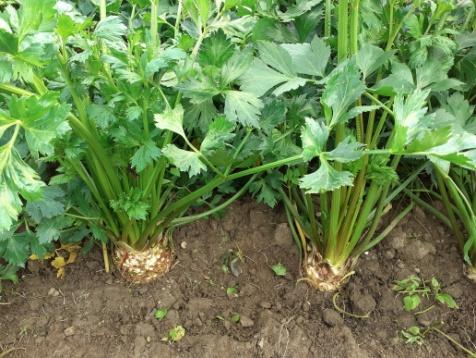
Celeriac
Origin and history:
It is a biennial plant, native to the Mediterranean regions and grown for centuries for its aromatic roots and leaves. The Dacia variety was developed at the Vegetable Research and Development Station (V.R.D.S.) in Buzau, Romania, with the aim of providing an adaptable and productive variety.
Botanical characteristics:
Dacia celeriac is a herbaceous biennial that develops a globe-shaped tuberous root weighing 750 g – 1 kg, creamy white in colour, with a fine texture and an intensely aromatic taste. The leaves are large, dark green and glossy, with well-defined petioles. The plant can reach a height of 40-50 cm in its first year of growth.
Growing conditions:
Dacia celeriac prefers fertile, well-drained soils with a neutral or slightly alkaline pH. It can be grown in early spring (March-April), either from seedlings or by sowing directly in the field. It is a plant that requires constant but balanced watering in order to prevent the roots from splitting.
Care and maintenance:
The application of organic fertilisers or compost before planting is recommended in order to improve soil fertility. During growth, Dacia celeriac benefits from regular weeding and from mulching of the soil to conserve moisture. Moderate irrigation and, where necessary, the application of pest control treatments are important.
Propagation:
Dacia celeriac is propagated from seed, which is sown under protected cultivation (February-March) to raise seedlings, or directly in the field once the risk of frost has passed. The seeds take approximately 14-20 days to germinate, at temperatures of 18-22°C. The seedlings can be planted out 50-60 days after emergence.
Uses
Dacia celeriac is valued in the kitchen for its tuberous root, used in soups, broths, salads and side dishes, and also for its aromatic leaves, which can be used as an ingredient or as a seasoning. In addition, celeriac is known for its health benefits, having diuretic, antioxidant and digestive properties.