
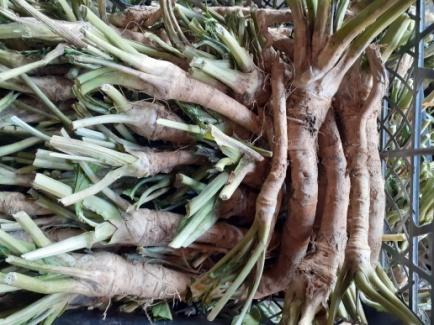
Horseradish
Origin and history:
It originates from south-eastern Europe and Western Asia and has been used over time both as a food and for medicinal purposes. The Georgian variety was developed at the Vegetable Research and Development Station (V.R.D.S.) in Buzau, Romania, and is valued for its aromatic, robust roots.
Botanical characteristics:
Georgian horseradish is a herbaceous perennial with thick, cylindrical, cream-white roots, a pungent taste and an intense aroma. The leaves are large and green, with irregularly toothed margins, and the plant can reach a height of 60-100 cm. It is renowned for its high productivity (which may range from 17-25 t/ha depending on crop density and management) and for its tolerance of varied climatic conditions.
Growing conditions:
Georgian horseradish prefers fertile, deep, well-drained soils with a neutral or slightly alkaline pH. The crop is established by planting root cuttings in autumn (October) or in early spring (March). It is a plant that withstands low temperatures and requires a site in full sun or partial shade.
Care and maintenance:
It is important for the soil to be well loosened before planting in order to encourage root development. Regular weeding and moderate watering help to keep the crop healthy. For good-quality roots, it is advisable to remove the side shoots so that the plant concentrates its energy on the main root.
Propagation:
Georgian horseradish is propagated from root cuttings, which are cut into segments 15-20 cm long. These are planted in the soil at an angle of 45°, with the upper end positioned approximately 5 cm below the soil surface. The plants will emerge within 2-3 weeks, depending on temperature conditions.
Uses
Georgian horseradish is used in the kitchen as a condiment, added to sauces, pickles and various traditional dishes on account of its pungent aroma. It also has recognised medicinal properties and has traditionally been used to stimulate digestion and for its antiseptic and anti-inflammatory effects.