
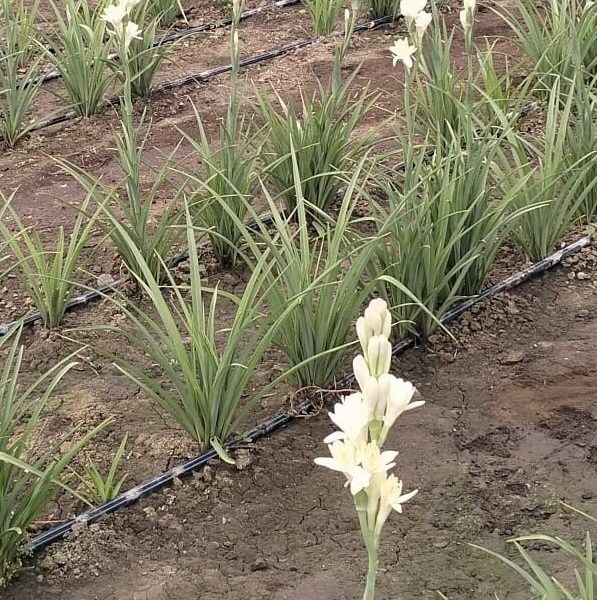
Description
Origin and history: Tuberoses (Polianthes tuberosa), known in Romanian also as chiparoase, originate from Mexico and are prized for their fragrant, beautiful flowers. These plants are grown both for ornament and for the use of their flowers in perfumery. The Avatea variety was developed at the Vegetable Research and Development Station (V.R.D.S.) in Buzau, Romania.
Botanical characteristics:
- Tuberoses have a stem approximately 100 cm tall and an underground stem in the form of a corm.
- The leaves are light green and approximately 30-50 cm long.
- The flowers are white, large and tubular, with a powerful scent.
Growing conditions:
- It prefers humus-rich, well-drained, sandy soils.
- The soil should be ploughed in autumn to a depth of 25-30 cm and worked to a fine tilth in spring.
- Watering is carried out frequently and regularly, especially in summer.
Propagation:
Tuberoses are propagated by bulbs, which are grown on for 2-3 years in dedicated propagation plots.
Large bulbs may be planted directly in the garden 20 cm apart, towards the end of April and the beginning of May.
Uses: Tuberoses (Polianthes tuberosa) have numerous uses, both in ornamental gardening and in other fields.
- Ornamental: Tuberoses are grown for their fragrant, beautiful flowers, which are used in bouquets and pots and for decorating gardens and parks.
- Perfumery: The floral essence of the tuberose is used in the perfume industry to give fragranced products an exotic, pleasing scent.
- Traditional medicine: In some cultures, tuberoses are used in natural remedies for the treatment of certain complaints.
- Aromatherapy: Tuberose flowers are used in aromatherapy products to encourage relaxation and reduce stress.
These uses make the tuberose a valuable plant both in amenity gardening and in other fields.